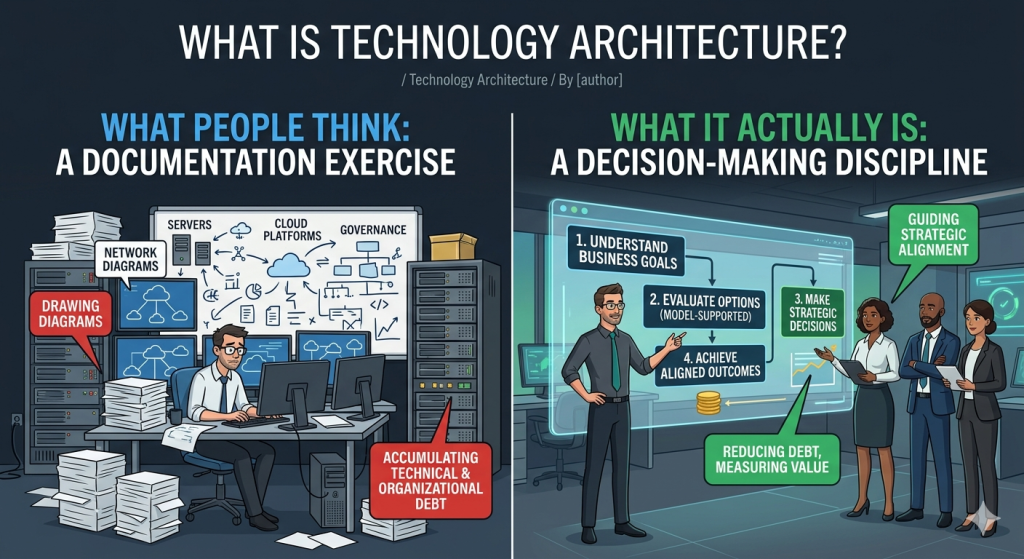
Ask ten IT professionals what technology architecture is. You will get ten different answers. Most will describe something technical — servers, cloud platforms, network diagrams. Ask what an architect actually does, and they will say: “they draw diagrams” or “they choose technologies.”
Both answers are incomplete. And this misunderstanding is expensive.
The wrong mental model
Organizations that reduce technology architecture to a documentation exercise or a technology selection process produce isolated IT projects with inconsistent outcomes. They accumulate not only technical debt, but organizational debt: misaligned processes, unclear responsibilities, governance gaps that cost far more to fix than any outdated server.
Here is the premise this blog is built on:
Technology architecture is a decision-making discipline, supported by models — not a modeling discipline that occasionally informs decisions.
This distinction is not semantic. It changes everything about how an architect operates, where they spend their time, and how their value is measured.
Where technology architecture sits
Technology architecture does not exist in isolation. It is one of four interconnected domains that together form Enterprise Architecture (EA): Business architecture, Data architecture, Application architecture, and Technology architecture.
This sequencing is intentional. Business needs determine data requirements. Data requirements shape application choices. Application choices determine technology needs. Technology is the last domain, not the first.
When organizations reverse this sequence — selecting technology before understanding business needs — they create precisely the misalignment that architecture is meant to prevent. Every “let’s go cloud-first” or “we need to containerize everything” initiative that is not grounded in upstream business requirements is an example of this reversal.
What technology architecture actually covers
Technology architecture encompasses the decisions, standards, patterns, and principles that govern an organization’s infrastructure and platforms. Not the implementation — the governance of it.
Concretely, this means:
Standards — the approved technologies, protocols, and configurations that define how systems are built and operated. Standards reduce variance, promote reuse, and lower the cost of decision-making at the project level. An encryption standard set before the first deployment protects every system that follows. Set after the breach, it is not architecture — it is incident response.
Building blocks — reusable, technology-agnostic descriptions of capabilities that can be realized by different solutions depending on context. Building blocks are the currency of consistent architecture.
Patterns and reference architectures — proven structural solutions to recurring problems. Zero-trust security models, event-driven architectures, microservices patterns. Teams get a starting point rather than a blank page.
Governance mechanisms — the Architecture Review Board (ARB), the technology radar, the standards catalog, and the decision frameworks that ensure architectural decisions are consistent, visible, and enforceable across the organization.
What it is not
Clarity requires boundaries.
It is not infrastructure management. Infrastructure management operates existing systems. Technology architecture defines the principles that govern how those systems should be designed and evolved. One is operational; the other is structural.
It is not documentation. Diagrams and models are the deliverables of architectural thinking — not its purpose. The purpose is better decisions. A 200-page network architecture document that nobody reads produces no architectural value.
It is not a technology selection process. Choosing between AWS and Azure, or between Kafka and RabbitMQ, is an engineering decision. Architecture establishes the principles that guide those choices — cost, interoperability, operational maturity, strategic alignment — but it is not its role to make those calls.
A useful mental model: architecture as an operating system
An operating system does not run applications — applications run on it. But it determines what applications can do, how they interact, what resources they can access, and how they behave under load.
Technology architecture works the same way. It does not build solutions — solutions are built on it. But it determines what solutions are possible, how they interact, what standards they must respect, and how the organization responds when things go wrong.
This has a practical implication: the quality of your architecture is visible in the quality of your projects. When projects are fast, consistent, and reuse existing components, the architecture is working. When every project reinvents the wheel, makes incompatible choices, and creates integration debt, the architecture — or its governance — has failed.
The central tension: depth vs. governance
Here is the hardest truth in this discipline.
Technical depth is a prerequisite for architectural governance — not a contradiction with it. A technology architect who does not understand asymmetric cryptography cannot govern their organization’s PKI. An architect who does not understand network topologies cannot approve an SD-WAN architecture. Governance without technical depth is not governance — it is superficial validation. And the teams know it.
But technical depth without governance is equally insufficient. The brilliant architect whose work remains on paper, who gets absorbed by project execution and loses sight of the coherence of the whole — that is a different failure mode, and just as common.
The sweet spot: an architect who understands the systems they govern deeply enough to detect risks and evaluate proposals, while having the governance rigor to ensure those decisions are consistent, traceable, and organizationally aligned.
That is what this blog is about.
What comes next
This post is the first in a series that mirrors the structure of my book Technology Architecture in Practice — from foundational concepts to technical domains to governance and leadership.
Over the coming weeks: the architect role landscape (and why the industry does not define it clearly), the principles that govern decisions under uncertainty, architecture building blocks in practice, and then domain-by-domain coverage — cloud, security, networks, identity, observability, and more.
Each post is written for practitioners. Not for an academic audience. Direct where it needs to be direct.
If this framing resonates — or if you want to push back on any of it — the comment section is the right place.